international women's day
posted on 03-08-2019 by scotty
I’ve always felt quite a bit of brand loyalty to Nike. For a long time, I thought maybe it might be because I was from Oregon, where a fledgling shoe import business went on to change sport and commerce forever. Or maybe it was reading Phil Knight’s autobiographical novel describing his journey from college athlete to businessman that made me feel like Nike’s story was my story. Maybe it was that I was a runner, and Nike’s brand kept my favorite pastime alive. Maybe I just liked seeing that shiny swoosh stare back at me in the mirror—a symbol of status or success.
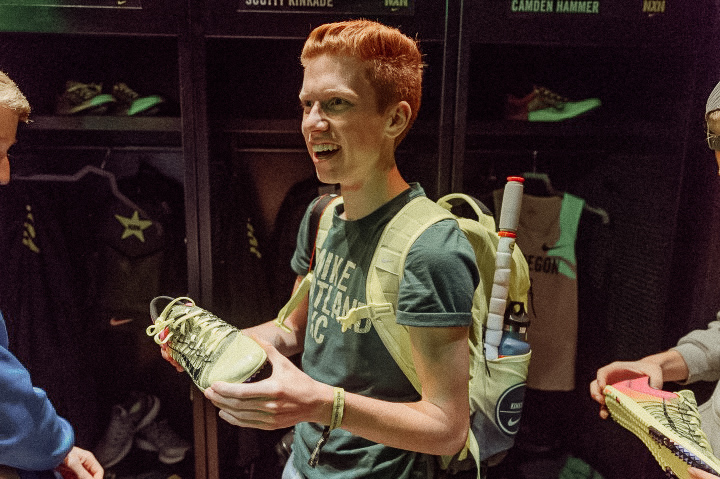 a totally candid shot during the gear-up ceremony in the tiger woods building at nike world headquarters in beaverton, oregon december 1, 2016
Michael Hansen, director of Sports Marketing for Nike, came and spoke in my intro to marketing class during my first year of college. He shared that marketing is about more than products. Of course, what ends up in your customer’s hand holds incredible value in and of itself, but creating moving experiences and reaching the heart of your customer makes every shoe, shirt, and soccer ball mean something more. Nike has a legacy of emotional advertising, but Michael hinted at particularly significant campaigns to come. A few months later, the iconic “Dream Crazy” campaign featuring Colin Kaepernick launched and was wildly successful. Fortune favored Beaverton’s boldness, but that wasn’t my favorite campaign of the last year— that goes to a movement kickstarted by Serena Williams’ story, “Dream Crazier.”
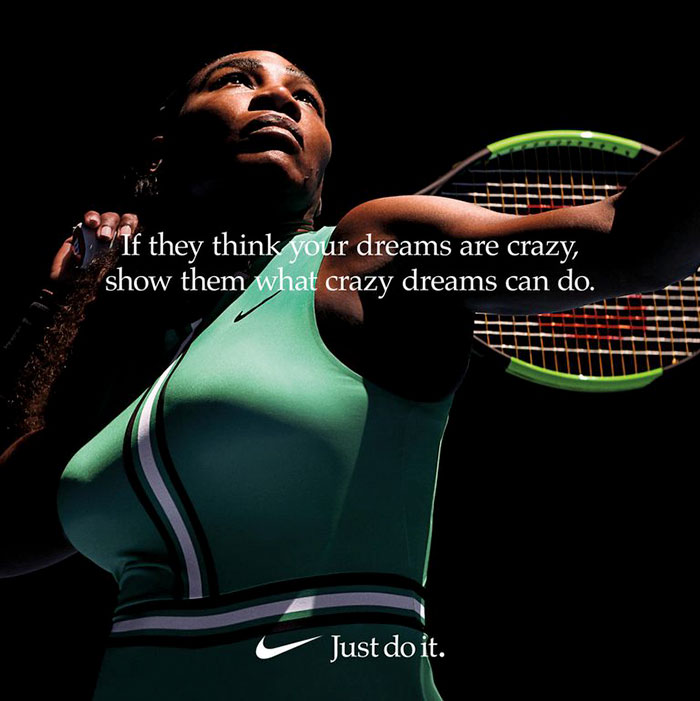 image courtesy of nike
Capitalizing on the momentum of the #MeToo movement, Dr. Christine Blasey Ford’s testimony at the Supreme Court confirmation hearings, and the rise of fourth-wave feminism, Nike declared 2019 the year of the woman. Beginning with the video narrated by Serena Williams, which had its official debut at the Oscars, the campaign wasn’t about highlighting a particular product. Instead, Nike’s team focused on showcasing one of their core values—empowerment. Other ads in the campaign echoed the same sentiment; Joan Benoit Samuelson showcased her enduring commitment to her craft in the face of adversity, 40 years and 150,000 miles after her historic win at the Boston Marathon. Another ad featured the best women in professional athletics literally screaming—letting out battle cries as they relentlessly pursued their sporting and fitness goals. They even featured Caster Semenya, a ground-breaking move considering her influence as a championship-winning athlete who is widely considered to be intersex. Nike’s feminist soapbox is hardly the most controversial; there was no call to “bow down bitches” mingled with startlingly true realizations from Chimamanda Ngozi Adichie’s iconic TED talk like in one of Beyoncé’s many anthems of empowerment, ***Flawless. But their message and intent were clear: women, particularly women in sport, are incredible, and they deserve more recognition.
Nike’s promise to do more for women isn’t empty—as Pamela Danziger described in a recent piece for Forbes, the design team from the world’s leading apparel brand recently introduced the first hijab designed for women athletes and redesigned their premier sports bra to be even more functional and comfortable, now fitting through size 44G. When a campaign is focused less on individual products or collections and more on the company’s brand, it can be hard to track the real impact or even ROI, but according to Danziger, Nike has seen double-digit growth from their products for women in Q2 of 2019 alone. However, I would postulate that this play for Nike is about more than immediate growth—a true return on their investment would be growth in the participation, coverage, and fanbase of women’s sports (which, in turn, would grow their business). Ultimately, to harness the words of Chimamanda Ngozi Adichie, Nike’s aim is to reform the way we see women as competitors—not for the attention of men, but for the next demonstration of incredible human performance. The “Dream Crazier” campaign made it clear: Nike stands for feminism. That is, the social, political, economic, and (I would add) sporting equality of the sexes.
 with my mom, peggy, at historic hayward field in may of 2016